
AI in 2025: Beyond Chatbots and Image Generators
Explore how AI in 2025 is transforming industries, driving innovation, and reshaping daily life far beyond chatbots and images.
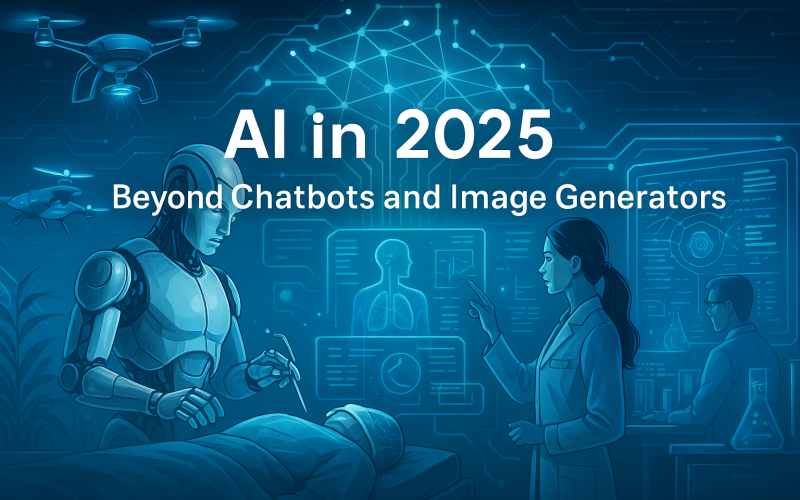
When most people think about artificial intelligence (AI), they picture chatbots answering customer queries or image generators creating realistic artwork. While these tools have made headlines over the past few years, AI in 2025 has moved far beyond text and pictures. Today, AI is reshaping industries, solving complex problems, and even redefining what’s possible in science, healthcare, and daily life.
We’ve entered a new era—one where AI is no longer just a novelty, but a core driver of innovation.
From Conversations to Complex Solutions
The first big wave of AI adoption came from natural language processing (NLP) models like ChatGPT, which revolutionized how we interact with machines. The second wave was powered by generative AI for images, audio, and video, opening creative opportunities across industries.
Now, in 2025, we’re seeing the third wave of AI—applications that go far beyond content generation and conversational tasks. This new phase focuses on automation, prediction, personalization, and decision-making in real-time, often without human intervention.- AI-Powered Healthcare Breakthroughs
- Early disease detection: AI models can spot cancer in its earliest stages using advanced medical imaging.
- Personalized medicine: Treatments are tailored to each patient’s unique biology.
- Drug discovery: AI can identify potential new drugs in months rather than years, drastically reducing research costs.
- Autonomous Systems and Robotics
- Logistics & supply chain: AI robots handle sorting, packing, and delivery faster and more accurately than humans.
- Agriculture: Autonomous machines plant, water, and harvest crops using AI-powered environmental sensors.
- Manufacturing: Factories run on self-learning systems that adapt to changing production demands in real time.
- AI in Scientific Discovery
- Climate modeling: AI predicts the effects of environmental policies with high accuracy.
- Material science: AI identifies new eco-friendly materials for electronics and construction.
- Energy innovation: AI designs more efficient solar cells and battery systems.
- AI in Education and Workforce Development
- AI in Creative Industries: More Than Just Art
- Film & gaming: AI creates realistic virtual worlds, complete with AI-driven characters who can think and adapt.
- Music: AI composes original pieces tailored to specific moods or events.
- Architecture: AI designs sustainable buildings optimized for local climates and resources.
- AI Ethics and Governance in 2025
- Data privacy: Protecting user information from misuse.
- Bias reduction: Ensuring AI decisions are fair across all demographics.
- Explainability: Making AI decision-making processes understandable to humans.
- AI in Everyday Life
- Personal AI assistants manage finances, health, and daily schedules with precision.
- Smart homes use AI to anticipate needs—adjusting lighting, temperature, and even grocery orders automatically.
- Personalized shopping experiences recommend products that truly match individual preferences and habits.
What’s Next for AI Beyond 2025?
Looking ahead, AI is expected to move even closer to general intelligence, where machines can understand, learn, and apply knowledge across diverse tasks, much like humans. The next five years may see:- AI-powered medical nanobots operating inside the human body.
- Fully autonomous cities with AI managing traffic, waste, and utilities.
- AI-driven climate engineering to reverse environmental damage.
Conclusion: AI’s True Potential Lies Beyond the Obvious
In 2025, AI has gone far beyond chatbots and image generators. It’s diagnosing diseases earlier than ever, creating scientific breakthroughs, making industries more efficient, and improving everyday life in ways we couldn’t have imagined a decade ago. We’re entering an era where AI is less about replacing human work and more about expanding human potential. The challenge now is ensuring it develops responsibly—so that the benefits are shared widely, and the risks are carefully managed. In short, the AI revolution isn’t coming. It’s already here—and it’s just getting started.
Comments
Leave a comment Replying to
Comments are reviewed before they appear. Your email is never published.