
Holographic Communication: The Future of Meetings
Explore holographic communication and its potential to revolutionize meetings, offering immersive and interactive virtual experiences.
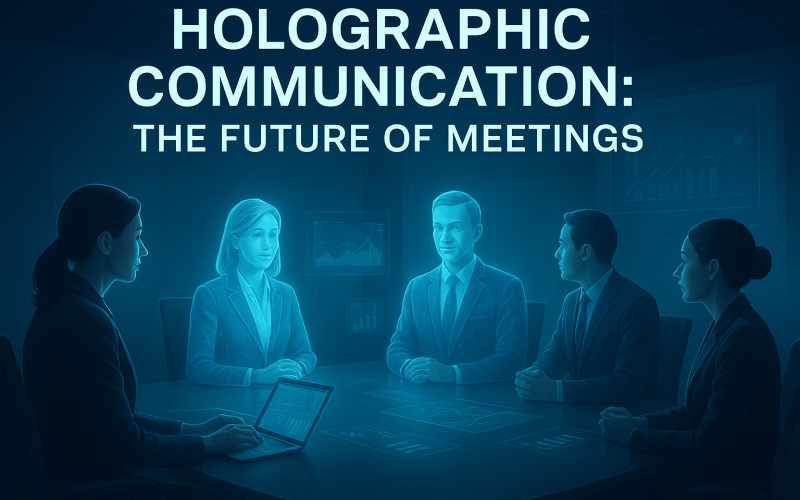
In an age where technology is advancing faster than ever, the way we connect and collaborate is undergoing a revolution. From handwritten letters to emails, from conference calls to video conferencing, communication has always evolved to suit the needs of society. Now, we stand at the brink of the next big leap: holographic communication. Imagine stepping into a meeting room and seeing your colleague from another continent appear as a life-sized, 3D hologram right in front of you. No screens, no flat video feeds—just a realistic, interactive presence that feels almost as if they’re physically there.
This futuristic vision is not far away. In fact, holographic communication is already emerging, and it promises to transform how we conduct meetings, collaborate globally, and even build relationships across borders.
What Is Holographic Communication?
Holographic communication uses 3D holographic projections to create life-like representations of people, objects, or environments. Unlike video calls, which display participants on a flat screen, holography allows you to see a full three-dimensional image that can move, interact, and respond in real time. These holograms can be projected into meeting rooms using specialized hardware, or viewed through AR/VR headsets and even advanced smart glasses. The result is a communication experience that goes beyond “talking on screen”—it feels like being in the same room.Why Holography Matters for Meetings
Meetings have always been a cornerstone of business, but traditional formats—whether in person or online—come with limitations.- In-person meetings are often costly, requiring travel, time, and resources.
- Video conferencing has made remote meetings accessible but lacks the depth and human connection of face-to-face interaction.
Benefits of Holographic Communication in Meetings
- Stronger Human Connection
- Global Collaboration Without Travel
- Immersive Presentations
- Accessibility and Inclusion
- Competitive Edge
Real-World Examples of Holographic Meetings
- Microsoft Mesh: Microsoft is developing a platform that allows holographic presence through AR headsets like HoloLens. This technology enables people to collaborate in shared holographic spaces.
- PORTL Hologram Devices: Startups like PORTL have created life-sized hologram booths that allow someone to “beam” into a room in real time. These devices have already been used for corporate talks and entertainment.
- Telepresence Experiments: Companies like Cisco and ARHT Media are experimenting with holographic telepresence for executive meetings and keynote addresses.
Challenges and Limitations
Of course, like any emerging technology, holographic communication faces hurdles:- High Costs: The hardware and software required for high-quality holograms are expensive, though costs are expected to drop as adoption grows.
- Bandwidth and Infrastructure: Streaming life-sized 3D holograms requires massive data and ultra-low latency—something that may only be possible with widespread 5G and 6G networks.
- Learning Curve: Users will need to adapt to new devices like AR glasses or hologram booths.
- Privacy and Security: As with any digital communication, protecting data and preventing misuse will be essential.
The Future of Holographic Meetings
Looking ahead, holographic communication is likely to evolve in exciting ways:- Mainstream Adoption: Just as Zoom became a household name during the pandemic, holographic meeting platforms could become standard tools in global businesses.
- Integration with AI: Virtual assistants could appear as holograms in meetings—summarizing discussions, translating languages in real time, or presenting data.
- Hyper-Realistic Avatars: Advances in motion capture and 3D scanning will make holograms indistinguishable from real human presence.
- Hybrid Work Revolution: As remote and hybrid work become the norm, holography will provide the “best of both worlds”—the human connection of in-person meetings and the flexibility of remote work.
Conclusion
The future of meetings is no longer limited to conference rooms or flat video calls. Holographic communication promises a paradigm shift, making meetings more immersive, engaging, and productive. From reducing travel costs to strengthening human connection, the potential is enormous. While there are still challenges to overcome, the trajectory is clear: in the coming decade, holograms will likely become as commonplace in boardrooms as video calls are today. In the words of many futurists, the ultimate goal of communication technology is to make distance irrelevant. Holographic meetings are a giant leap toward that vision—turning the dream of “being there without being there” into a tangible reality.


Comments
Leave a comment Replying to
Comments are reviewed before they appear. Your email is never published.